Identify
the usefulness of discussing space/time rather than simple space.
Having
reached the conclusion that absolute time cannot be defined independently
of a particular reference frame, Einstein then goes on to discuss
the measurement of space and time intervals.
If
the observer, O/ in the carriage, wants to determine
the length of the carriage then this can be easily done by taking
a ruler and measuring along a straight line, say along the carriage
floor. However the observer, O on the embankment, has a problem
in measuring the length of the train; this is because in relativistic
terms they cannot be sure that they are seeing both ends of the
train simultaneously. What O must do, is arrange two markers,
say A and B, that correspond to each end of the train and are
seen to be at each end of the passing train by making an observation
exactly half way between A and B.
This midpoint observation will confirm that A and B were
simultaneously opposite the ends of the train. Once this has been
checked, then O can also measure AB, which is the length of the
train, using a ruler. We can also suppose that before O/
climbed aboard, both the rulers used by the different inertial
observers were compared and calibrated. Despite all these precautions,
Einstein points out that we will find that the measurements of
distance (as distinct to position) taken by the two observers
do not agree. In fact our experience of relativity now tells us
that the length of the moving train, as measured from the embankment,
will be shorter than the measurement taken aboard the train.
As
well as showing that length intervals will differ when compared
between inertial observers, Einstein also stated that time intervals
will differ between inertial observers.
The
Lorentz transformations
Account
for the need, when considering space time, to define events using
four dimensions.
At
this stage Einstein introduces the Lorentz Transformations. Although
he derived these in his first 1905 paper on Special Relativity
he was aware that Lorentz had already introduced these to explain relativistic phenomena in
1904.
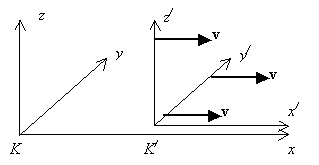
The
particular choice of the transformations belongs to the two inertial
axis systems shown below.
The
Galilean assumptions for this system are:
v
Time intervals are independent of the motion
of the frame, t2 – t1 = t/2 – t/1.
v
The distance between two points is independent
of the motion of the frame,
x2 – x1 = x/2 – x/1.
v
Events at various points are may occur simultaneously
for both frames.
v
 .
.
v
For light travelling through a vacuum in the
+x-direction, c/ = c – v.
ALL
THESE ASSUMPTIONS NEED TO BE MODIFIED!
Explain
quantitatively the consequence of special relativity in relation
to – length contraction and – time dilation.
For
physical situations where v
® c it has become clear
that the first three assumptions do not hold. The last one is
now contradicted by Einstein’s second postulate: The velocity of light in a vacuum is the
same for all inertial observers. The theory of relativity
uses the Lorentz equations
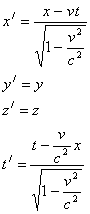
and
using these we can see how the first two assumptions are modified
and the last confirmed. These modifications apply for all speeds
v < c.
Einstein’s
postulate concerning the constancy of the speed of light is easily
confirmed from the Lorentz transformations. If a light signal
moves through the K frame according to

then
we substitute this value of x into the first and last equation to
get
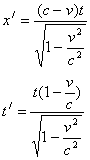
and
by a simple rearrangement we can show that
x/ =
ct/.
Thus
we conclude that the light signal also moves through the K/
frame according to a similar equation and with the same speed.
The
inverse Lorentz transformations can be found from the above using
algebra, or more simply by using physical intuition. If reference
frame K/
moves with a relative speed of v
with respect to reference frame K,
then we can also say that K moves
with a speed of –v
with respect to K/. Hence we have
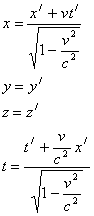 . .
Einstein
demonstrates length contraction in the following manner. Consider
a one metre rod in the K/ reference frame, travelling with speed v in the x/ direction. The ends are given co-ordinates (x/1, y/1, z/1) = (0, 0,
0) m and (x/2, y/2, z/2) = (1, 0,
0) m, (you should see from here that it is aligned parallel to
the relative velocity). Now we measure these ends from the K frame of reference at the time t = 0, ie the measurements are made instantaneously in the K frame. Turning to the first of the
Lorentz transforms (not the inverse ones given above) we put in
our values to get

and
 . .
From
these two equations we can see that the length of the metre rule
when observed in the K frame is
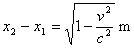 . .
It
follows, very simply, using the inverse transformations that if
a metre rule in K, (1,
0, 0) to (0, 0, 0) m is measured from K/,
then
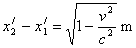 . .
Both
observers will record a length contraction when they observe the
dimensions in from each inertial frame. The measurement of length
of an object that has relative motion, Lv, relates to the length
that would be observed if the observer was travelling with the
object, Lo, according to the equation
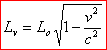 . .
The
time dilation is nearly as easy to derive from the Lorentz equations,
there is a problem that the clock which is stationary in one frame
of reference must be changing position in the other. Suppose a
clock was placed at (0, 0, 0) in the K/ frame. This clock then registers a one second time
interval by indicating t/1
= 0 and t/2
= 1 s. For the first time measurement in the K
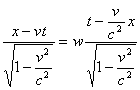
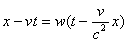
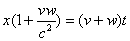
frame we use the Lorentz transformations
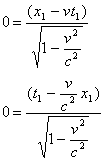 . .
These
two equations give conflicting relations between t1
and x1, this can be resolved by
using both t1
= 0 and x1 = 0. For the second time
measurement in the K
frame we use
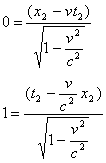 . .
From
here we find

and

so
that
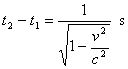 . .
If
we place a similar clock at x = 0, in the K frame of reference and apply the inverse Lorentz transformations,
then we will find
x/2 = -vt/2
and
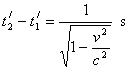 . .
The
time interval measured for a system that has relative motion,
tv, relates
to the time interval that would be measured if the observer was
travelling with the object, to,
according to the equation
 . .
These results will be discussed further under the Twin
Paradox.
(More on Twin Paradox: see this web
site)





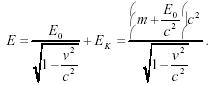


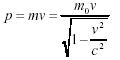

Please
note that the special relativity notes can be viewed using
Acrobat Reader, which has been included on this cd here.
 BACK TO TOP
|
















 .
.
 .
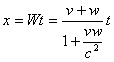
.
 .
.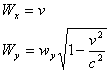 .
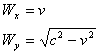
.
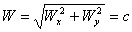 .
.
 . Using
one of the typical mathematical approximations that were so necessary
before the invention of computers, Einstein was able to write
. Using
one of the typical mathematical approximations that were so necessary
before the invention of computers, Einstein was able to write
 become infinitesimally small. Einstein explained that the kinetic
energy of a body had two parts, the rest part,
become infinitesimally small. Einstein explained that the kinetic
energy of a body had two parts, the rest part,
 then changes to the system could occur according to
  would
correspond to a large amount of energy given out from the system
would
correspond to a large amount of energy given out from the system
 This
is one of the most famous equations of the twentieth century,
as late as 1920 Einstein wrote “A direct comparison of this relation
with experiment is not possible at the present time …”.
This
is one of the most famous equations of the twentieth century,
as late as 1920 Einstein wrote “A direct comparison of this relation
with experiment is not possible at the present time …”.  as the rest mass of the moving object.