Following a direct translation of Einstein we quote the first of
these laws: "A body removed
sufficiently far from other bodies continues in a state of rest or
of uniform motion along a straight line." In his statement,
Einstein is concerned about the effect of gravitation, so he
supposes that the body is far from all other bodies in order that
it does not experience any appreciable gravitational attraction.
More generally he is describing a body on which no outside
(external) forces are acting. We need not concern ourselves with
the internal forces that hold the body together as we assume that
the body is rigid and that the sum of these internal forces is
zero. For Einstein, the above law is all that is necessary, he
simply calls this the
Law of Inertia. You will recall that there are two other principles
that are generally added to this first law.
The second law can be stated as: "The rate of change of momentum of a body is
proportional to the external force that acts on the body." We
can write this law in the form of the formula
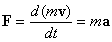 . .
We comment here that the right-hand result follows if the mass
does not change with time or the velocity of the object.
Einstein's theory of special relativity shows that the mass of a
body does change with its velocity, hence the simple equation (F = ma) needs to applied with some care when dealing with relativity. It
is popularly supposed that Einstein "proved Newton to be wrong",
but this is a gross overstatement of the case. The laws used by
Galilei and Newton work so well (except at speeds near that of
light through a vacuum) that it took a genius and many years of
research to extend the law to a more general form that had to
include the theories of relativity.
The third law can be stated as: "Every force is balanced by an equal and
opposite force." In the case of internal forces in a rigid
body, this principle is fundamental for the application of the
principles of statics. However for external forces, the principle
needs some clarification. If an external force is causing
acceleration, then it is opposed by the inertia (or mass) of the body that is
accelerating. If a force F
causes a body to accelerate with
a, then that body resists the force by using its inertial mass m = F/a.
When considering gravitation, we find that the mass of a
body determines the strength of the gravitational force, for
example the weight force of a body is
W = mg. Although this is a
different definition of mass, Einstein generally assumed the
inertial mass was equivalent to the gravitational mass. As
Einstein usually extended his thinking to a cosmological scale he
was mostly concerned with gravitational force rather then
mechanical forces. At one point in his writings, he points out
that if an observer in an enclosed system (with no way of looking
outside) feels a mechanical force acting on the system, then the
observer may validly suppose that the force is some type of
gravitational force. Einstein also acknowledges that if an
intermittent force (pulsing with time) were applied, then a
careful observer would need to modify their understanding of
gravity.
The
fact that an enclosed observer cannot distinguish between a
gravitational force and a mechanical force must be kept in mind,
this problem bothered Newton and it took some concentrated
thinking from Einstein to keep the distinctions and work out the
Special and General Theories of Relativity. As we follow
Einstein's reasoning quite closely, the conclusions may seem quite
strange and counter-intuitive and at first you may need to take
them on trust. Rest assured that the conclusions have been tested
for nearly one hundred years and they have been found quite
reliable. Please note that the
special relativity notes can be viewed using Acrobat Reader,
which has been included on this cd here.
Next Page >>
 BACK TO TOP
|