Outline the nature of inertial frames of reference.
Physicists, mathematicians, engineers and indeed most common
people, use the Cartesian coordinate system as they find their way
around the surface of the earth. This system requires three
perpendicular
x-, y- and z-axes (often north- east- and up-) with a common length scale
(metres) along each axis. These systems extend uniformly
throughout our three dimensional space. When bodies move through
space, their position coordinates change with time. A particular
position or
displacement forms a
vector from the origin of the chosen axis system. It is always
possible to choose another Cartesian system to describe the same
space, these may have different origins and different orientation
of the axes. While we move about these systems we also experience
the flow of time as a scalar. However we occasionally recall that
we can still see back into the past as we look at distant stars.
As he speculated, Einstein was aware that we see all objects in
the past because we must wait until the light from these objects
reaches us before we see them. We usually forget this fact when we
view our immediate environment and thus assume that we see objects
and events simultaneously to their occurrence. Again here is a
reason why we need to be patient and consider what Einstein taught
although it often seems counter-intuitive. When considering the
role of an observer in relativity, we mean something more than seeing. An
observer is an intelligent and thoughtful person who has access to
all forms of technology eg. clocks, rulers, telescopes video
recorders etc.. An observation is made when an observer receives
information and is able to scrutinise and analyse all aspects of
that observation. Despite our advances in technology, there are
still many things that we cannot yet do, or observe, for this
reason Einstein pioneered the use of "thought
experiments" so that logically possible, but technologically
impossible, results could be anticipated and incorporated into our
physical laws.
As moving bodies change their position co-ordinates in time we
define the concepts of velocity, speed and acceleration. Although
no acceleration can be constant, we find no need to give special
names to the higher derivatives that describe changing
acceleration etc.. In fact we can usually account quite well for
our position and the position of objects around us by assuming
that the accelerations (or at least their magnitudes) are
constant. Some of the motion equations that should be familiar to
you are:
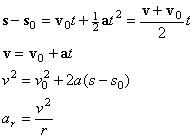
As we use the relative displacement (s - s0) and the relative velocity (v - v0) we
should also use relative time (t
- t0). Relative time is an
important concept in simple but sequential models, however this is
often obscured when we write
t in place of t -
t0.
We also need an understanding of an
inertial frame of reference, this was originally called a
Galilean system of co-ordinates by Einstein. These are simply a
system of co-ordinates in which the law,
"A body removed sufficiently far from other
bodies continues in a state of rest or of uniform motion along a
straight line." holds. A body in a state of rest or uniform motion
along a straight line does not experience any unbalanced external
forces. The converse, if a body feels no forces it must be at rest
or in motion along a straight line, is not true. For instance you
would feel no forces in free fall (we usually neglect air
resistance) or, astronauts don't feel any forces while in orbit
about the earth. In free fall you would observe your acceleration
with reference to the earth to which you are falling. In the orbit
you would observe that you are rotating about the earth and this
rotation requires acceleration.
Einstein supposed that we could imagine we had an
inertial reference frame that was far out in space removed from
all significant gravitational fields. However for greater clarity
he, and other teachers, drew on more practical examples such as
trains, trams and more recently aeroplanes. These vehicles can
move with uniform velocity (motion
along a straight line),
at the same time the local gravity can be felt but the vehicles
are supported as they travel in straight lines. Within the
vehicles the passengers feel just as if they were at rest on the
earth's surface. This fact is a simple illustration of relativity,
the familiar laws of science operate in a vehicle moving with
constant velocity relative when close on the earth's surface. For
instance you can safely pour a cup of coffee in an aeroplane
without worrying about the sideways speed of say 250 m s-1.
The bigger questions concerning what happens when the vehicles
must turn on the earth's surface, the rotation of the earth or the
orbital motion of the earth about the sun, etc. can be set aside
on the assumption that for a short time the vehicle travels with a
constant velocity. Somebody standing watching the vehicle pass is
also at rest or moving with a relative velocity in the other
direction to the vehicle. The vehicle is one inertial frame, the
ground from which it observed is another, any other vehicle, also
moving with a constant velocity, is yet another inertial frame of
reference.
As Einstein pondered these matters, he became increasingly aware
that his first Theory of Relativity rested on an assumption that
motion along a straight line was possible. But what is a straight
line? He also knew that he simply couldn't escape the universal
gravitational field, no matter where he imagined his thought
experiments. These considerations led to the second more General
Theory of Relativity. For our purposes we will confine ourselves
to initially considering just the first Special Theory of
Relativity. We must be satisfied that we can imagine inertial
frames where the reference axes (or rigid vehicle) does not
accelerate, even if gravitational forces can be felt.
Next Page >>
 BACK TO TOP
|