Now
we return to the railway train crossing the embankment.
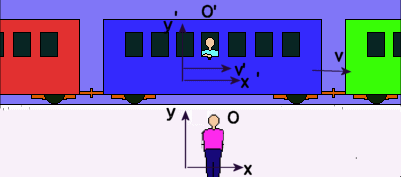
In
the figure you can see an observer O standing by the embankment in the
inertial frame K. Passing
by is the carriage, which represents the inertial frame K
/, and which contains
the observer O/ at the centre of the carriage. The carriage, and hence the inertial
frame
K
/ is moving with a speed v
in the +x-direction
and the +x/–direction, (v is the speed
of velocity v). We will now present a series of pictures
showing the how observations (remember these include measurements
and calculations) appear in the K
frame of reference. This series shows lightning striking each
end of the carriage simultaneously and then the light from the
events radiating outwards from where the lightning struck. The
light, or information, radiates out in what may be called information
spheres.
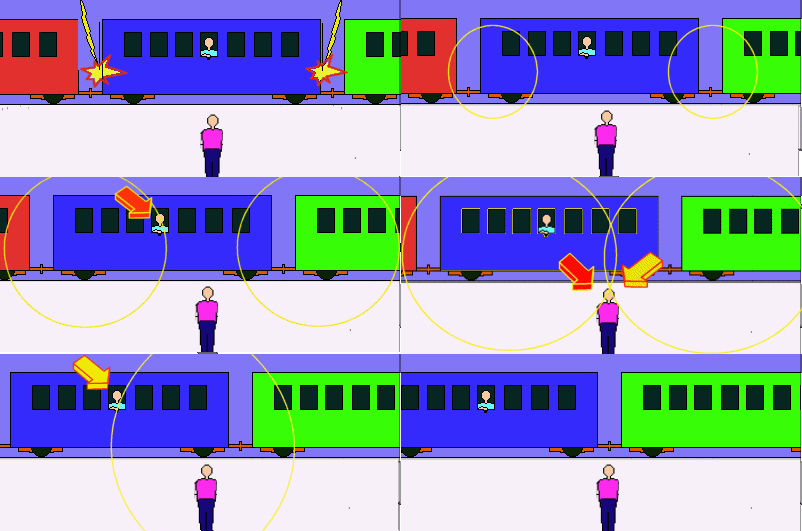
In
the figure above we see the lightning strike each end of
the carriage simultaneously. Neither O nor O/ are aware
that anything has happened. A short time later O/
, who has moved towards the oncoming information sphere, becomes
aware that lightning has hit the front of the carriage; at this
time O is still unaware that anything has happened. O then becomes
aware that lightning has hit both ends of the carriage simultaneously,
O/ is still moving to the right and unaware of the
second strike. Finally, O/ becomes aware of the second
lightning strike.
Both
observers receive the information at the speed of light c.
Both observers are aware of the relative motion of the other observer.
Observer O argues that the lightning struck each end of the carriage
simultaneously, but because O/ was moving forward,
O/ became aware of the strike at the front of the carriage
before learning about the strike at the back of the carriage.
Observer
O/ disagrees with the sequence of events related by
O. To see why, we need to consider the same observations in the
K/ frame.
The observations must agree with the previous observations however
the past projection of events need not agree. The observations
are: O/ records lightning from the front of the carriage,
O records both strikes at the same time and then O/ records lightning from the back of the carriage. We will now
present a series of pictures representing the observations taken
in the K/ frame of reference.
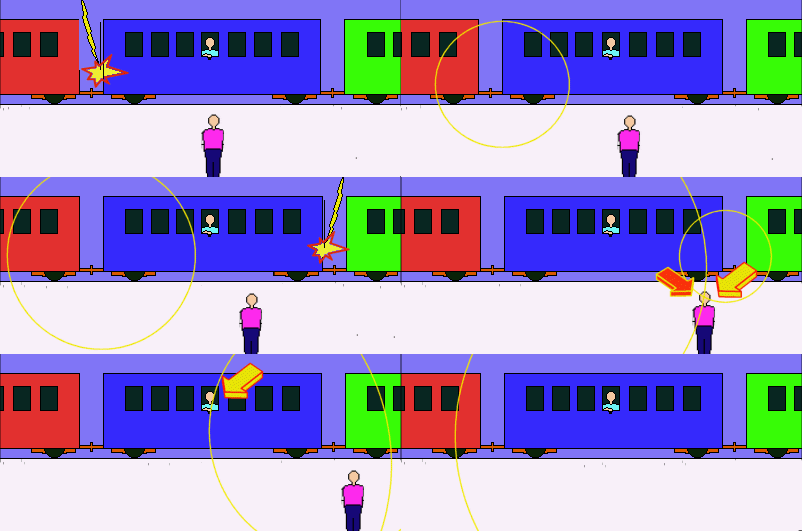
In this figure we see the events of lightning striking first the
front and then the back of the carriage. Neither O nor O/
have made any observations. A short time later O/
, receives the oncoming information sphere, while O, who has a
relative motion to the left, is still unaware that any lightning
has hit the carriage. O then becomes receives the information
that lightning has hit both ends of the carriage simultaneously.
Finally, O/ receives the later information of the second
strike.
Explain
qualitatively the relativity of simultaneity.
Please
note; according to all the observations of the observer O in the
K frame (the embankment),
the lightning strikes were simultaneous. However; according to
all the observations of the observer O/ in the
K/ frame (the railway carriage), lightning first hit the front of the
carriage and then later hit the back of the carriage.
If
you have got this far and find this last result contradictory,
then congratulations, you have reached the initial core of Einstein’s
explanation of Special Relativity. In the above result the laws
of physics in the ‘embankment’ inertial frame of reference show
that lightning struck both ends of the carriage simultaneously.
The same laws in the ‘carriage’ reference frame say that lightning
did not strike both ends of the carriage simultaneously. There
can be no further questions about what really happened? No other
background observer can be called upon to resolve this paradox
and say what really happened. The two valid, but different, inertial
frames of reference saw the occurrences in a different fashion;
that is what really happened.
The
explanation is based on logic perhaps this explains why Einstein
took pains to reach this conclusion without using any mathematics.
By changing the word system
to frame we have his
following important statement:
“Every
reference-frame (co-ordinate system) has its own
particular time; unless we are told the reference-frame to which the statement of time refers, there is no meaning
in a statement of the time of an event.”
We
can give a simple example. Suppose the entire universe was created
throughout space in an instance of time, this is often called
creation ex nihilo.
This being the case, it would not be sensible to try and put an
age on this type of universe, as various parts of the universe
would appear to have different ages and these particular ages
would be different for different inertial observers.
Next Page >>
 BACK TO TOP
|