Discuss
the principle of relativity.
Discuss
the concept that length standards are defined in terms of time
with reference to the original meter.
In
the previous two sections we have reviewed some of the physics
and maths that you should have already met in high school. Some
of you may have found the explanations rather elaborate with a
strange choice of speculative topics. This approach is considered
necessary because we are travelling into unfamiliar territory.
We
have already covered the first four or five chapters of Relativity,
the Special and the General Theory in our preceding sections.
We did this so that we could gain an introduction using the terminology
and knowledge that is common at the present time. These early
chapters outline the problem of defining a straight line and also
explain what is meant by a "Galileian system of co-ordinates";
now called “inertial frames of reference”.
We
proceed to a first example. Imagine a passenger in a railway train,
moving with constant speed across an embankment, drops flowers
from the window of the carriage. This passenger will observe the
flowers to fall straight down and hit the embankment (again we
ignore the effect of air resistance). From the train, the embankment
will appear to move with a relative speed in the opposite direction
to that of the train. However to an observer, standing beside
the embankment, the flowers will fall with a parabolic trajectory
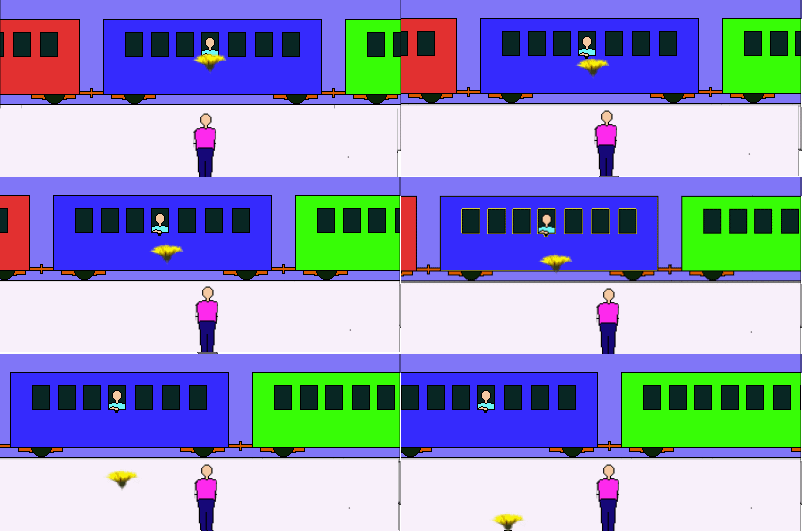
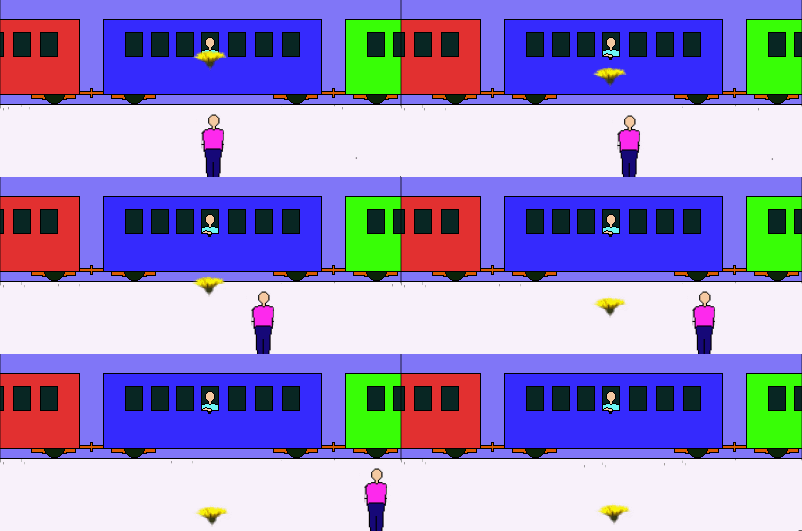
while the train moves. This situation is illustrated in the following
set of diagrams.
In
the top figure we see the observation from the reference frame
of the embankment, both the carriage and the flowers have moved
to the right as the flowers fell.
In the bottom figure we see the observation from the reference
frame of the carriage, the flowers have fallen vertically while
the observer on the embankment had a relative motion to the left.
From
these relative observations we learn that what appears to be a
straight line in one inertial frame is obviously a curved line
in the other inertial frame. Because of this, we could not for
instance state a law that says, "All objects fall straight down."
This isn't true for the different inertial observers. We could
however say, "All objects accelerate straight down." This is true
for all inertial observers (although we need to define the direction
'down').
There
was another, subtle point that Einstein drew attention to in this
example. As far as the observer in the carriage is concerned the
flowers hit the ground directly below the centre of the carriage,
this being a measurement of position in the passengers inertial
frame. The observer beside the embankment sees the flowers hit
the embankment further down the track, this occurs in the observer's
inertial frame. The common feature that both observers should
agree on is the relative the speed of the train. However, to compare
where the flowers fell, they would need to know when
the flowers fell. The observer beside the embankment could say
"I saw the flowers hit the embankment beside the big brown rock."
However the passenger in the train will say the flowers hit the
embankment below the middle of the carriage. To agree on the position
of where the flowers fell, they also need to know when the flowers
hit the ground. Further, the time of impact needs to be set relative
to some other agreed time such as the time when the flowers were
dropped, with both observers being opposite reach other. Once
these details are fixed, both observers will be able to calculate
how far along the embankment the flowers landed.
All
this may seem rather like splitting hairs, but for the purposes
of relativity it is important detail. In our usual world we travel
very slowly compared to the speed of light and so we assume that
we see nearby events at the same time as they happen. Even in
this familiar environment, we know that we see a lightning strike
before we hear the corresponding peal of thunder. We assume that
we see the lightning instantaneously with the lightning strike,
or as we are forced to admit, almost instantaneously. At relativistic
speeds the observer's inertial frames could be moving close to
the speed of light and "almost instantaneously" is simply not
accurate enough.
The
passenger in the train and the observer on the embankment gives
us an uncomplicated and familiar example of two inertial frames
of reference. Einstein generalises to a mass m that may move with a constant velocity
in a frame of reference K
(co-ordinates x, y, z) and a second frame
of reference
K/ (co-ordinates
x/,
y/,
z/) that moves with a constant velocity, v with respect to K. He then states his first principle of
relativity: “ …natural
phenomena run their course with respect to K/ according to exactly the same
general laws as with respect to K.” He suggests that the mechanical
laws of Galilei and Newton would ‘hold good’, that is apply with
perfect validity in different inertial frames. As a cosmologist
he explains that these laws hold with a great accuracy amongst
the stars and this accuracy is quite wonderful, he never felt
that he had somehow proved laws to be wrong.
One
immediate outcome of this first principle is that there can be
no preferred inertial frame of reference. Perhaps Einstein was
sensitive to the public condemnation of Galilei Galileo after
he announced that the earth was not the centre of the universe.
In effect Einstein is saying that if there is a centre of the
universe we will not be able to distinguish it from any other
point.
You
will be asked to show that the earth orbits the sun with a speed
of 30 km s-1, while this orbit must involve a small
radial acceleration,
 , we can treat our motion as almost in a straight line for short
time periods. However, throughout the year this orbital speed
moves in different directions. Einstein explains that even the
most careful observations of stars show no change in the laws
of physics throughout the year.
, we can treat our motion as almost in a straight line for short
time periods. However, throughout the year this orbital speed
moves in different directions. Einstein explains that even the
most careful observations of stars show no change in the laws
of physics throughout the year.
Next Page >>
 BACK TO TOP
|