The usual approach to joining tissues severed in accidents
or surgery is by suturing with needle and thread. This
is a skilled, time-consuming technique.
On a microsurgical
level the work is much harder, manipulating needles as
fine as human hair (less than 100 microns in diameter)
and thread with a diameter of 30 microns. Although lasers
are used increasingly as surgical tools for cutting and
vaporising tissues, Dr Judith Dawes and her colleagues,
at Macquarie University's Centre for Laser Applications
(CLA),
use lasers, not to cut or vaporise tissue, but much more
gently - to heat and thus "weld" or "solder" tissues
together.
Earlier techniques of laser tissue welding joined
two tissues together by heating the tissue at the join.
This relies on coagulating or cooking the protein in the
tissues, in the same way that egg white is coagulated by
heat. The direct heating of the tissues leads to considerable
thermal damage to the tissues, hindering tissue regeneration.
This is obviously unacceptable for repairing nerves, for
example. In order for the laser light to heat the tissue,
the light must be the right wavelength or colour to be
absorbed. A dye is added to the tissue to absorb the near
infrared laser light efficiently.
Dr Dawes and colleagues,
in collaboration with the Microsearch
Foundation of Australia,
have developed and patented a new protein "solder" which
is a protein mixture that is applied to the tissue and
heated to strengthen the join. Existing fluid solders consist
of dye and albumin solutions, which tend to run when they
are applied, and they are difficult to control and localise
at the tissue join.
The CLA team has developed a solid
protein solder with dye mixed into it. Three or four
of these tiny 'bandaids' can be applied across the severed
ends of the tissue. These solder bands are then cooked
using a low-power semiconductor diode laser; the dye
ensures
that the laser light is absorbed by the solder and not
by the tissue.
Successfully trialled on nerves in rats,
the CLA-Microsearch solid solder technique has proved
to have lots of advantages. It is quicker and easier
than suturing, and, as trauma inside the nerve is reduced,
it
leads to less scarring. Compared with fluid solders,
the solid solder requires half the laser energy, which
naturally
produces less thermal damage to tissues, and gives
stronger
bonds that can withstand higher stresses. Over time,
the protein solder is resorbed by the body, and the actual
site of the laser solder repair in the rats could not
be
identified after 3 months.
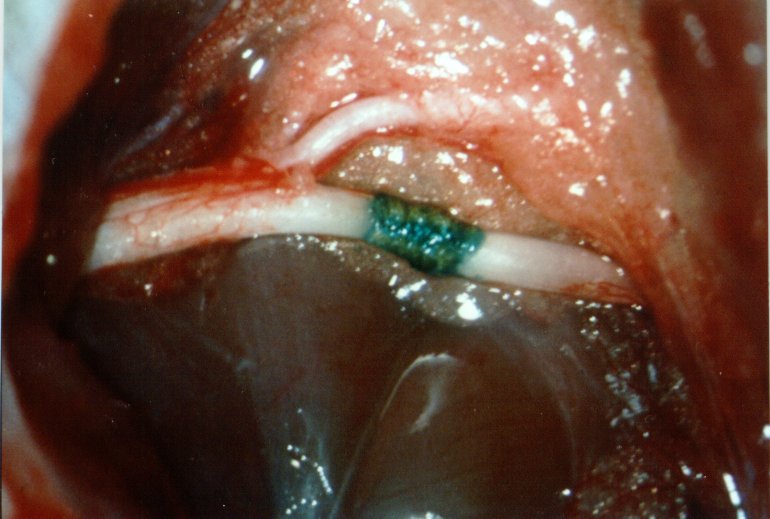 |
A rat tibial nerve immediately after it was repaired
using the protein solder. This nerve took some weeks
to regenerate and the protein solder was resorbed by
the body in about 6 weeks.
The next phase of research involves exploring the use
of the laser soldering technique on other tissues and
the team is targeting arteries. |
No other research groups
have thus far succeeded in laser-soldering arteries so
the join can withstand the blood pressure inside arteries,
in
particular the aorta, which carries the highest pressure
in the circulatory system. If sutures are required to strengthen
the join, the simplicity and advantages of using lasers
are lost.
Moreover, suture holes can leak. When the arterial
wall is disturbed, so that blood is no longer in contact
with the inner lining of the artery, the blood begins to
clot immediately. Therefore, ideally when an artery is
repaired,
the artery lining should remain continuous.
How then to
create a strong bond and protect the lining at the same time?
The
surgical team has devised an ingenious technique, which
was adapted from an earlier reported surgical approach using
metal tubes. This technique uses a hollow tube of protein
solder.
When the protein solder is heated for a short time
in hot water or steam, after shaping into the desired form,
it becomes more flexible, easier to handle during surgery
and more robust. It can be shaped into a hollow tube, in
a range of wall thicknesses and lengths, to suit different
vessels or different animals. When surgically repairing
arteries or other tubular tissues, the protein solder acts
as a sleeve.
One end of the severed blood vessel is threaded right through
the protein sleeve, and folded back over the sleeve. It
is laser treated to bond to the solder. The other severed
end
is then pulled partly over the sleeve and laser treated
to finish the join. In each case, the laser bonds the solder
tube to the vessel by irradiating through the tissue.
Successfully demonstrated to repair rat aortas, the sleeve
technique
with
solid protein solder is being studied in other animals.
Suitable operating instruments are being devised to
simplify the sleeve
technique for a range of vessel types.
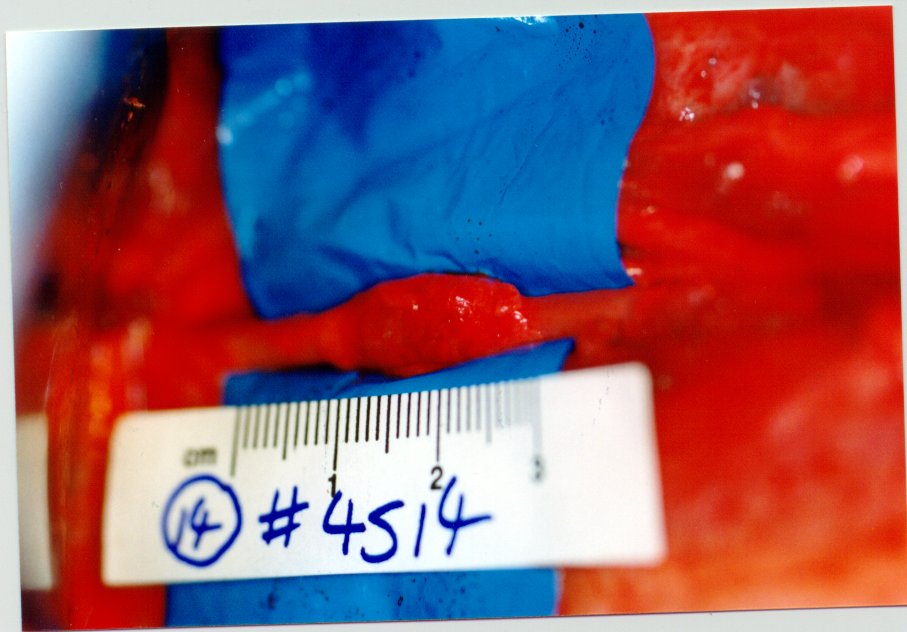
A sheep femoral artery which was repaired using the
solid protein solder a year before. The repair site is
evident as the protein solder has not completely been
resorbed by the body yet. However the blood is flowing
normally.
Dr Dawes and associates at Macquarie also have another
invention to their name, the growth and demonstration
of a new laser crystal, ytterbium-doped yttrium aluminium
borate, or Yb:YAB. |
 |
YAB
is the crystal host for the active ion impurity, Yb. This
interesting crystal has the unique ability to act as both
laser and nonlinear optical crystal. Infrared photons are
converted by a nonlinear process into visible green photons,
thereby allowing a whole range of wavelengths to be emitted
out of a single laser. This work has resulted from a very
fruitful collaboration with Chinese and Japanese researchers
and has plenty of commercial potential.
Researchers:
Dr Judith
Dawes, Professor Jim Piper
Physics Department.
Some Publications:
J.M. Dawes, A. Lauto, R.I. Trickett, E.R. Owen, "Laser
tissue welding for microsurgical repair of nerves" Australian
Optical Society News, 10, 21-24, (1996).
K.M. McNally, J.M. Dawes, A.E. Parker, A. Lauto, J.A. Piper,
E.R. Owen, "Laser-activated solid protein solder for
nerve repair: in vitro studies of tensile strength and solder/tissue
temperature" Lasers in Medical Science, 14, 228-237
(1999).
P.K.M. Maitz, R.I. Trickett, P. Dekker, P. Tos, J.M. Dawes,
J.A. Piper, M. Lanzetta, E.R. Owen "Sutureless microvascular
anastomoses by a biodegradeable laser activated solid protein
solder" Plastic and Reconstructive Surgery, 104, 1726-1731,
(1999).
 BACK TO TOP
|