|

For over ten years, scientists under Professor Jim Piper's
guidance at Macquarie University's Centre for Lasers and
Applications (CLA) have been researching and developing
new lasers and their applications. During this time, the
CLA has become one the biggest and most respected centres
of knowledge in laser technology, particularly in the area
of Copper Vapour Lasers (a laser source that emits 10,000
green & yellow pulses every second).
Research conducted at the CLA has led to significant increases
in the stability, power output and beam quality of these
copper lasers, which makes them perfect ultra-high precision
micromachining tools. When the Olympic Torch manufacturers
found conventional drilling methods inadequate for their
task they turned to the CLA's laser micromachining group.

Invented in the 1950s and 60s, lasers were recognised even
then as the tools of the future and have since gone on
to become widely used commercially (supermarket scanners,
police
radars, marking barcodes on wine bottles) and even within
the home (CD players, computers). One of the first instances
of somebody using a laser in a practical way was when
a scientist used a lens to focus a laser beam onto a
metal
surface and
the resulting heat removed some material. Since then,
optical drilling (rapid vaporisation of the metal) has
enjoyed
huge success as a manufacturing tool. In fact, large
industrial lasers like CO2 lasers are now in common use
for very accurate
drilling of everyday items such as automotive body parts
and mobile phone components.
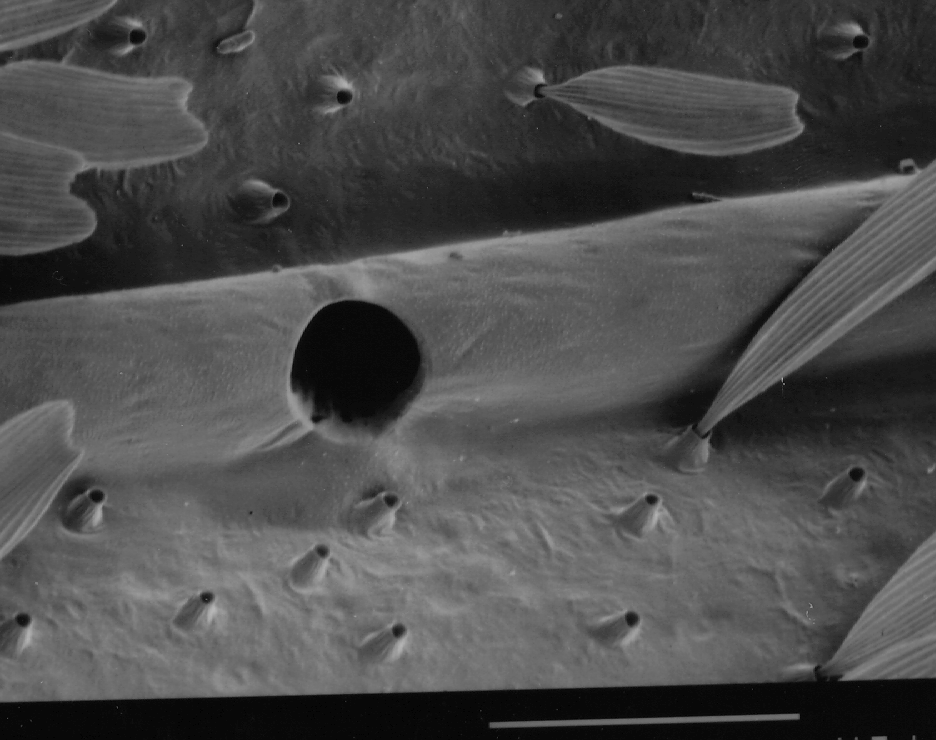 |
Hole of diameter 1 micron in moth wing
Due to the technological advances of
the last decade, new laser sources were needed for
sensitive applications
in the biomedical, aerospace, automotive and electronic
industries. The laser beam for this kind of drilling
required very special attributes to be able to drill
holes in delicate materials with an accuracy of about
one hundredth of the thickness of human hair. |
Short-pulse lasers
(pulses of light less than <0.0000001 seconds) were
shown to be ideal for this task, producing a constant rapid
stream of small impacts like a jack-hammer, rather than
the freight train effect of "continuous" (non-pulsed)
lasers.
Thousands of pulses are required to drill holes, but because
each pulse carries only a tiny amount of energy, there
is little or no effect on the material outside the target
zone.
If this were not the case, there would be serious consequences
with the intense heat causing damage to the surrounding
live tissue in surgical applications or other sensitive
surfaces
used in delicate manufacturing.
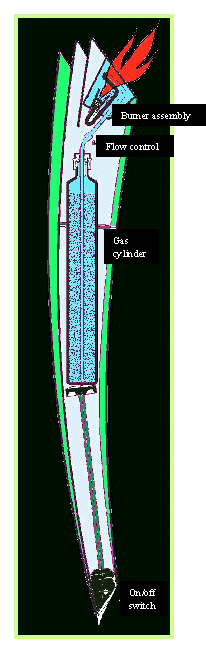
Schematic of the Olympic Torch
[Artwork by Blue Sky Design]
In
order to keep the torch's weight as low as possible
the interior gas canister and flow control system
were designed to be as lightweight and compact as
possible.
The delivery system for each of the 14,000 torches
for the Olympic torch relay was designed to give
a constant burn rate by passing the gas through a
tiny
aperture exactly 75 microns in diameter. This micro-orifice
had to be perfectly round with an allowable variation
of only 1-micron (one-hundredth the width of human
hair). If the hole were cut any larger, the torch
would not burn for the specified 20 minutes, any
smaller
and wind or rain could extinguish the flame. In order
to fulfil these precise requirements for the flow-control
orifice in the Olympic torch, CLA researchers investigated
two drilling techniques.
Percussion drilling, pulsing again and again on
one spot, could not produce a perfectly round
hole. But the second method, known as trepanning,
proved extremely successful in the quest for
exceptionally round holes. The holes were drilled
by rapidly moving the sample in a minute circular
motion under the stationary beam.
This
meant that each pulse in the beam chewed out tiny
bits of the metal less than 20 microns depth at a time, slowly
enlarging the hole into a regular round shape (much like a
woodpecker does in a tree stump).
|
|
Exceptional
results were obtained when drilling the 75-micron hole
in the 250-micron thick brass component of the torch. Happily,
given the 14,000 orifices to be drilled, the large number
of pulses (10,000 per second) delivered by the copper laser
meant that each aperture required only a minute to drill
through.
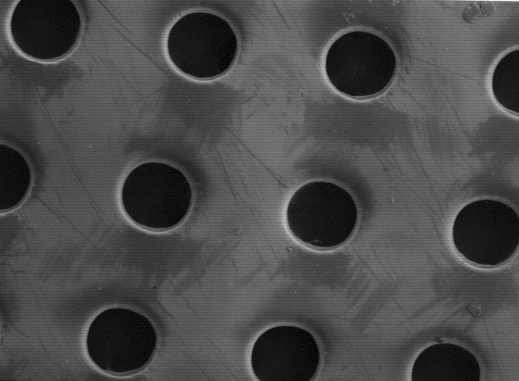 |
A
matrix of micro-holes trepanned in a polymer.
Physicists in the CLA have also conducted
a great deal of work on ablation and drilling of
plastic materials
using ultra-violet lasers. Passing the visible copper
laser light through a crystal of beta-barium borate
halves the wavelength of the light (from 511nm to 255nm).
|
This idea was conceived because they needed
an ultra-violet laser source to micro-machine in materials
that don't absorb visible light, like glass or polymers.
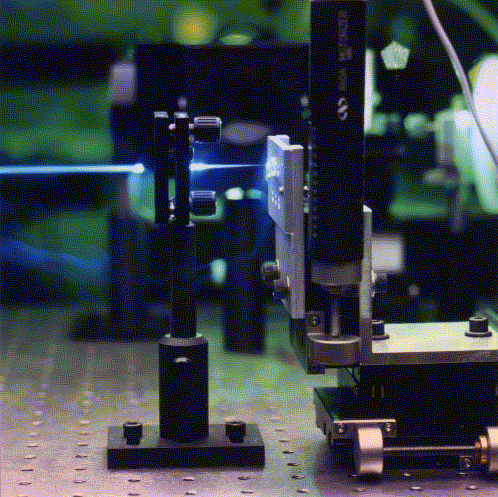
UV machining set-up
One example of this technology at
work is the manufacture of medical catheters, devices
that need a smooth, regular
flow produced by an evenly spaced array of exact-sized
microscopic holes. Another use in the commercial environment
creates a given hole size in pharmaceutical packaging
to enable the calibration of leak detectors. |
 |
In order to pass quality tests, companies
must make sure that their machines can accurately detect
holes between 5-30 microns in their product packaging.
Researchers at the CLA are continuing to perfect the micromachining
techniques in order to push the current limits of resolution
and precision. New applications for this kind of precision
technology are constantly emerging, and there is a steady
stream of inquiries from industry both in Australia and
overseas.
Researchers:
Professor Jim
Piper - Director of CLA
Dr Daniel Brown - Assoc. Director of CLA
Dr Michael
Withford - Post Doctoral Fellow
Elizabeth
Illy - PhD student
Jenn
Fishburn - PhD student.
For more information about micromachining at the CLA please
contact: Centre for Lasers and Applications
Physics Department
Macquarie University NSW 2109 AUSTRALIA
Ph: +61 2 9850 8911
Fax: +61 2 9850 8983
 BACK TO TOP
|



















 More
Info
More
Info